
LoRaWAN Cattle Tracking System for Smart Grazing and Virtual Fence Management
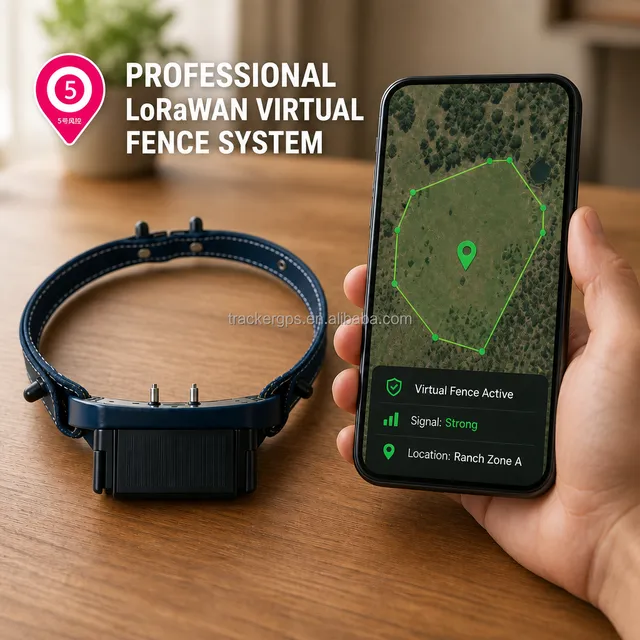
Managing cattle across large ranches, mountain pastures and remote grazing areas creates challenges that traditional livestock management methods cannot always solve efficiently.
Farm managers need to know where cattle are located, whether animals have left an approved grazing zone, how different paddocks are being used and whether a tracker is operating normally.
A LoRaWAN cattle tracking system provides a practical way to connect cattle, gateways and livestock management software through a long-range, low-power IoT network.
Instead of installing a cellular SIM card in every animal tracker, cattle can wear GPS-enabled LoRa or LoRaWAN collars that transmit positioning and status information to strategically deployed gateways.
The system can then forward data to a cloud platform or private server, allowing ranch managers to monitor livestock through a computer, Android application or iOS application.
For large farms, this architecture can become the foundation for cattle positioning, escape alerts, virtual fencing, rotational grazing and digital pasture management.
From Cattle Location Tracking to Smart Ranch Management
A conventional GPS tracker mainly answers one question:
Where is the animal?
A modern livestock IoT system should answer several additional questions:
- Which pasture is the animal currently using?
- Has it entered or exited a restricted area?
- How long has it remained in one location?
- Is the collar battery level normal?
- When did the device last communicate?
- Which animals are separated from the main herd?
- Which grazing zones are being used most frequently?
- Does a particular area have communication blind spots?
This changes the role of the GPS collar.
It is no longer simply a location tracker. It becomes an IoT data terminal connected to the entire ranch-management infrastructure.
For farms that need long-range livestock positioning without installing an individual cellular subscription in every collar, a LoRaWAN GPS Cattle Collar can provide an efficient architecture for large-scale cattle monitoring.
How a LoRaWAN Cattle Tracking Network Works
A typical cattle tracking deployment contains four major components:
GPS cattle collars → LoRaWAN gateways → Internet backhaul → livestock management platform
Each collar periodically wakes from low-power mode and obtains its position using GPS, BeiDou or another supported GNSS constellation.
The collar then transmits a relatively small data packet containing information such as:
- Device ID
- Latitude and longitude
- Battery level
- Time
- Motion information
- Alarm status
- Communication status
- Sensor information
A LoRaWAN gateway receives data from multiple cattle collars within its coverage area.
The gateway can then send this data to the server through communication methods such as:
- 4G
- Ethernet
- Wi-Fi
The ranch manager does not need to connect directly to each collar.
Instead, hundreds or potentially thousands of livestock devices can be organized through a centralized platform.
Why LoRaWAN Is Useful for Large Ranches
Large cattle farms frequently contain areas where cellular coverage is weak, unstable or unavailable.
Installing a SIM card in every cattle tracker can also increase operational complexity when a ranch manages a large number of animals.
LoRa and LoRaWAN are designed for transmitting relatively small amounts of IoT data over long distances while keeping device-side power consumption relatively low.
This makes the technology suitable for information such as:
- GPS positions
- Fence alarms
- Battery status
- Activity data
- Device health
- Sensor readings
However, LoRa communication range should never be treated as one fixed number.
Actual performance depends on the installation environment.
Important factors include:
- Mountains and valleys
- Trees and vegetation
- Gateway antenna height
- Antenna gain
- Collar antenna orientation
- Frequency band
- Transmission power
- Local radio regulations
- Buildings and other obstacles
For professional cattle-tracking projects, a small field test should therefore be completed before full-scale deployment.
Additional gateways can be installed between pasture areas when required.
Virtual Fencing Adds Intelligence to GPS Tracking
Knowing an animal's position is useful.
Knowing whether that position is inside the correct grazing zone is much more valuable.
A cattle virtual fencing system allows ranch managers to draw digital boundaries directly on a map.
These boundaries may represent:
- Grazing paddocks
- Restricted crop areas
- Road boundaries
- Water-source areas
- Breeding zones
- Quarantine areas
- Dangerous terrain
- Seasonal pasture areas
When cattle enter or leave a configured zone, the platform can generate an event.
Depending on the project and collar hardware, different virtual-fencing strategies can be implemented.
Some systems focus on location monitoring and escape alarms.
More advanced devices may support staged local warnings such as sound, vibration or other controlled behavioral cues.
A purpose-built Virtual Fence Cattle Collar can therefore become an important component of a digital grazing-management system.
Virtual-fence functions should always be configured according to livestock type, actual ranch conditions and applicable local animal-welfare requirements.
Rotational Grazing Without Rebuilding the Monitoring Network
Rotational grazing requires animals to move between different pasture areas over time.
With traditional management, changing the grazing layout may require opening gates, installing temporary fencing or rebuilding sections of a physical boundary.
Digital geofencing provides another management layer.
A ranch manager can divide the property into multiple digital paddocks through software.
For example:
Paddock A → active grazing
Paddock B → resting
Paddock C → future grazing
Restricted Zone → no cattle access
The active monitoring areas can then be adjusted as pasture conditions change.
This allows the same cattle tracking infrastructure to support multiple grazing-management strategies without physically changing the IoT network.
Historical movement information can also help ranch managers understand how cattle use different areas of the farm.
Solar Charging for Remote Cattle Trackers
Battery management is one of the most important engineering challenges in livestock GPS devices.
Every operation consumes energy, including:
- GNSS positioning
- LoRa transmission
- Sensor sampling
- Local processing
- Alarm detection
More frequent GPS reporting provides greater tracking visibility but generally increases energy consumption.
Therefore, system design requires balancing:
Tracking frequency ↔ communication frequency ↔ battery capacity ↔ operating time
Solar-assisted charging can be considered for cattle collars used in remote outdoor environments.
A properly engineered solar GPS cattle collar may extend field operating time and reduce the frequency of manual charging.
However, solar charging performance is affected by sunlight conditions, collar orientation, solar-panel size, battery chemistry and overall power-management strategy.
This is why battery life should be evaluated according to the complete device configuration rather than only battery capacity.
One Gateway Can Serve Many Livestock Devices
One important advantage of a LoRaWAN architecture is that a gateway does not belong to only one animal.
Multiple collars can communicate with the same gateway.
A large ranch can therefore create a distributed communication network by installing gateways at suitable high points or infrastructure locations.
A practical system may include:
Cattle Collar + LoRaWAN Gateway + Antenna + Solar Power + 4G Backhaul + Cloud Platform
Additional gateways can be added as the monitored pasture expands.
This makes the system suitable for phased deployments.
A farm might begin with a pilot installation covering a limited number of cattle and later expand to additional grazing zones.
What Ranch Managers Can See on the Platform
A professional livestock management platform should provide more than a simple map.
Depending on system configuration, managers can monitor:
Current Cattle Location
View the latest position reported by each cattle collar.
Historical Routes
Review previous animal movement and grazing patterns.
Electronic Fence Status
See whether livestock remain inside assigned grazing zones.
Escape Alerts
Receive notifications when cattle leave configured boundaries.
Battery Monitoring
Identify collars that may require charging, inspection or maintenance.
Device Communication Status
Check when a tracker last connected to the network.
Herd Organization
Group devices according to ranch, herd, pasture or customer project.
Remote Configuration
Adjust supported device parameters without physically collecting every tracker.
The goal is to transform raw GPS positions into information that ranch managers can use operationally.
LoRaWAN Cattle Tracking for Remote Farms
The technology is especially suitable for projects involving:
- Large beef cattle ranches
- Dairy farms
- Mountain pastures
- Remote grazing areas
- Sheep and goat farms
- Breeding farms
- Rotational grazing projects
- Government livestock projects
- Research farms
- Smart agriculture projects
The same system architecture can also be adapted for cattle, sheep, goats, horses and other grazing livestock.
Different animals may require different collar dimensions, straps, battery capacities and enclosure designs.
OEM and ODM Cattle Tracking Development
Commercial livestock projects often require more than purchasing an existing tracker.
Different markets may require different frequency bands, communication protocols, enclosures, battery capacities, logos, platforms and application functions.
Shenzhen Jinshengchang Technology Co., Ltd. provides OEM and ODM development for LoRa and LoRaWAN livestock tracking projects.
Customization can include:
- GPS / BeiDou / multi-GNSS positioning
- LoRa / LoRaWAN communication
- 4G communication options
- PCB hardware development
- Firmware development
- Collar enclosure customization
- Strap design
- Battery-capacity selection
- Solar charging
- Activity sensors
- Electronic geofencing
- Gateway integration
- API integration
- Communication protocols
- Cloud platform
- Private server deployment
- Android application
- iOS application
- Customer logo
- Product packaging
For system integrators and livestock technology companies, this allows one cattle-tracking solution to be adapted for different ranch environments and regional requirements.
Frequency Band Selection
LoRaWAN livestock projects need to use the appropriate frequency plan for the target country or region.
Depending on project requirements, available bands may include:
- EU868
- US915
- AU915
- AS923
- IN865
- RU864
- KR920
- CN470
Frequency selection should be confirmed before hardware production and field deployment.
Local radio regulations must always be considered.
API Integration and Private Platforms
Some customers already operate their own agricultural management system.
In these projects, livestock trackers do not necessarily need to use only the manufacturer's standard platform.
Device data can be integrated into a third-party system through:
- API
- SDK
- Communication protocol
- Private server deployment
This is especially important for distributors, agricultural IoT companies and large enterprise customers that need to combine cattle location information with existing farm-management software.
Building a Complete Smart Livestock Network
A successful cattle tracking project is not created by choosing a GPS collar alone.
The complete solution requires coordination between:
Hardware + Firmware + Wireless Network + Gateway + Server + Platform + APP + Installation
Gateway placement influences coverage.
GPS reporting frequency influences battery consumption.
Battery capacity influences collar weight.
Antenna design influences communication performance.
Server architecture influences the ability to manage large numbers of devices.
The strongest livestock tracking projects therefore evaluate the complete system before deployment.
Start with a Ranch Pilot Project
Before deploying hundreds or thousands of collars, it is usually better to begin with a smaller pilot.
The pilot can help evaluate:
- GPS positioning performance
- LoRa communication coverage
- Gateway installation locations
- Solar charging performance
- Battery consumption
- Collar mechanical design
- Virtual-fence accuracy
- Platform functions
- Alarm rules
- API integration
After field-testing the system, the deployment can be expanded according to actual ranch conditions.
This approach reduces installation risk and provides useful data for the final network design.
Conclusion
A LoRaWAN cattle tracking system combines livestock positioning, long-range IoT communication and digital pasture management into one connected infrastructure.
GPS collars provide animal location data.
LoRaWAN gateways connect large numbers of livestock devices.
Virtual fences transform positions into boundary and escape information.
Solar-assisted power can support long-term outdoor operation.
Cloud platforms, mobile applications and APIs turn the resulting data into practical management tools.
For modern ranches, the result is more than a cattle GPS tracker.
It is a scalable livestock IoT network designed for tracking, grazing management, virtual fencing and future smart-farm applications.
Shenzhen Jinshengchang Technology Co., Ltd. provides LoRaWAN cattle collars, livestock GPS tracking devices, gateways, software platforms and OEM/ODM development for global smart-ranch projects.