Horse LoRaWAN GPS Tracker for Long-Range Equine Location and Pasture Management
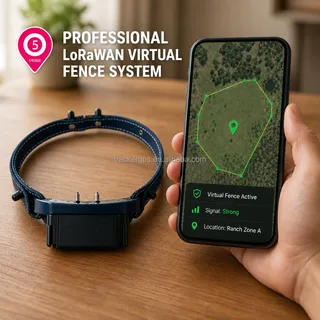
Managing horses across large pastures, breeding farms, ranches and remote grazing areas requires more than occasional visual inspections. A horse LoRaWAN GPS tracker combines satellite positioning with long-range, low-power communication, allowing owners to monitor horse locations, receive geofence alerts and review movement records without installing a SIM card in every tracking device.
Unlike a standard consumer GPS tracker that continuously relies on a cellular network, a LoRaWAN-based horse tracker sends location and status data to a nearby gateway. The gateway then transfers the information to a cloud platform through 4G, Ethernet or another internet connection. This architecture is particularly suitable for farms managing multiple horses within a defined area.
Why Use LoRaWAN GPS Tracking for Horses?
Horses may travel across large paddocks, wooded land or open grazing areas. Manual inspections take time, and locating an escaped, injured or separated horse can be difficult—especially at night or in poor weather.
A professional horse tracking system can help owners:
View the current or last reported location of each horse
Receive alerts when a horse leaves a designated pasture
Review historical movement routes
Identify prolonged inactivity or unusual movement
Monitor tracker battery level and online status
Manage multiple horses through one web platform or mobile application
Reduce time spent on routine location checks
The system is useful for horse farms, breeding centres, equestrian clubs, ranches, riding schools and conservation projects involving free-ranging horses.
How Does a Horse LoRaWAN GPS Tracker Work?
A complete system normally includes four components:
- Horse GPS tracker: Acquires the horse’s position through GPS, BeiDou or another GNSS constellation.
- LoRaWAN gateway: Receives location packets transmitted by trackers across the pasture.
- Network backhaul: Transfers data from the gateway to the server through 4G, Ethernet or Wi-Fi.
- Management platform: Displays horse locations, routes, alarms, battery levels and device status.
The tracker remains in a low-power sleep state for much of the time. It wakes according to a configured interval, obtains a satellite position and sends a compact data packet through LoRaWAN.
Reporting intervals can be adjusted according to the operational requirement. More frequent reports provide denser movement records but consume more power. Longer intervals extend battery endurance and may be more suitable for routine pasture monitoring.
LoRaWAN Does Not Replace GPS
GPS and LoRaWAN perform different functions in the system.
GPS or BeiDou determines the horse’s geographic coordinates. LoRaWAN transmits those coordinates from the wearable tracker to the gateway. The gateway then forwards the data to the server.
This distinction is important when designing a project. A tracker may successfully obtain a GPS position but still be unable to upload it if the LoRaWAN network does not cover that location. Correct gateway placement is therefore essential.
Horse-Specific Hardware Design Requirements
A tracker developed for horses should not simply be a cattle device with a different product name. Horses have different movement patterns, body structures and equipment requirements. The enclosure, attachment method and firmware must be evaluated for actual equine use.
Comfortable and Secure Installation
The device may be integrated into a neck collar, halter or another approved attachment structure. It should remain stable while the horse walks, runs, grazes or rolls, without causing excessive pressure or friction.
The mounting design should consider:
Tracker weight and dimensions
Contact points against the animal
Strap strength and adjustability
Resistance to loosening during movement
Prevention of sharp edges
Safe release requirements
Antenna orientation
The final attachment method should be tested with the intended breed and operating environment before large-scale deployment.
Weather and Water Resistance
Outdoor horse trackers may be exposed to rain, dust, mud, manure, sunlight and temperature changes. A sealed enclosure and durable connector design are therefore important.
Ingress-protection performance should be verified for the final assembled tracker rather than assumed from the enclosure material alone. Charging ports, cable openings and seams are common areas that require careful sealing.
GNSS Antenna Performance
The horse’s body, collar material and device orientation can affect satellite reception. The GNSS antenna should face an appropriate direction and remain reasonably clear of metal components.
Firmware can also improve practical positioning performance by controlling satellite acquisition time, assisted positioning data, retry logic and power consumption.
LoRaWAN Radio Design
Reliable pasture communication depends on more than the advertised range of the LoRa chipset. The radio-frequency design should account for:
Local LoRaWAN frequency regulations
Antenna efficiency
Device mounting orientation
Vegetation and terrain
Gateway antenna height
Spreading factor and data rate
Transmission power limits
Payload size
Network congestion
Supported regional frequency plans may include EU868, US915, AU915, AS923, IN865, RU864, KR920 or CN470. The correct version must be selected for the deployment country.
Virtual Geofence and Escape Alerts
A digital geofence allows the farm manager to define an approved grazing or activity area on the platform map. When a horse crosses the virtual boundary, the system can generate an alert.
Depending on the platform configuration, alerts may be displayed through:
Web-based management software
Android or iOS applications
Push notifications
SMS or email integrations
Third-party software through an API
Geofence accuracy depends on satellite conditions, reporting frequency and boundary configuration. The virtual boundary should include a reasonable buffer zone to prevent unnecessary alarms caused by normal GPS position drift.
For more advanced pasture projects, the horse tracker may form part of a broader livestock virtual fence collar system supporting centralized animal monitoring and configurable grazing zones.
Activity and Inactivity Monitoring
A motion sensor can record general movement status and help the system detect prolonged inactivity. This may help farm workers identify a horse that requires inspection.
Activity information can also support:
Daily movement comparisons
Grazing-pattern analysis
Separation detection
Escape-event investigation
Abnormal inactivity alerts
However, a GPS tracker is not a veterinary diagnostic instrument. Movement data should be treated as an operational indicator, and any health concern should be assessed by qualified personnel.
Battery-Life Strategy
Battery endurance is a critical factor in a horse LoRaWAN GPS tracker. Actual operating time depends on:
GPS acquisition frequency
LoRaWAN transmission interval
Satellite signal quality
Temperature
Battery capacity and condition
Motion-trigger settings
LoRaWAN data rate
Retransmission frequency
Alarm volume
Firmware power management
A sensible firmware strategy may use a normal reporting interval during routine activity and temporarily increase the reporting frequency after an escape alarm or abnormal event.
Solar-assisted charging can be considered for long-term outdoor deployments, but the solar panel must receive sufficient light and remain properly oriented. Solar charging should supplement an efficient power design rather than compensate for excessive energy consumption.
LoRaWAN Gateway Planning for Horse Farms
Gateway placement determines whether the system can reliably receive data across the property. A gateway should normally be installed at a high, unobstructed location with an outdoor antenna selected for the required frequency band.
Before installation, the project team should evaluate:
Total pasture area
Hills, valleys and terrain elevation
Trees and dense vegetation
Buildings and metal structures
Maximum horse movement range
Gateway mounting height
Availability of power and internet backhaul
Areas requiring redundant coverage
A single gateway may cover a large open area, but communication distance cannot be guaranteed solely from a theoretical range value. A site survey and field test are recommended.
For remote pastures without mains power or wired internet, an outdoor solar LoRaWAN gateway can provide solar power and 4G backhaul. Farms with existing power infrastructure can also deploy an outdoor LoRaWAN gateway with 4G and PoE.
LoRaWAN or 4G: Which Is Better for Horse Tracking?
Neither technology is universally better. The correct choice depends on how and where the horses move.
| Requirement | LoRaWAN tracker | 4G tracker |
|---|---|---|
| Individual SIM card | Usually unnecessary | Normally required |
| Private farm coverage | Very suitable | Depends on operator coverage |
| Large numbers of horses | Cost-effective architecture | Recurring SIM costs may increase |
| Movement outside the farm | Limited by gateway coverage | Suitable where cellular service exists |
| Power consumption | Generally lower | Generally higher |
| Infrastructure | Requires one or more gateways | Requires cellular coverage |
| Remote configuration | Supported through the LoRaWAN system | Supported through cellular communication |
A hybrid LoRaWAN and 4G tracker can also be developed. It may use LoRaWAN inside the farm and switch to cellular communication when the horse leaves private network coverage. This approach provides broader connectivity, although it increases hardware cost, firmware complexity and energy consumption.
Management Platform and API Integration
A professional system should manage more than map coordinates. The platform can associate every tracker with a horse profile containing the animal’s name, device ID, group, pasture and operational status.
Typical platform functions include:
Live or last-known location
Historical route playback
Multiple geofence management
Entry and exit alarms
Low-battery warnings
Device offline alerts
Activity and inactivity records
User and permission management
Batch device configuration
Android and iOS access
Data export
API integration
API access is valuable for farms that already use herd-management, breeding, security or asset-management software.
OEM Horse LoRaWAN GPS Tracker Development
Different equine projects may require different enclosures, attachment methods, battery capacities and reporting strategies. Shenzhen Jinshengchang Technology Co., Ltd. provides OEM and ODM development for LoRa GPS livestock trackers, gateways and IoT management platforms.
Customization can cover:
Horse-specific enclosure and mounting structure
Private mould development
LoRaWAN regional frequency
GPS and BeiDou positioning
Battery-capacity selection
Solar-assisted charging
Motion and activity sensing
Temperature sensing
Geofence and alarm logic
LoRaWAN and 4G hybrid communication
Customer protocol integration
Platform branding
Mobile application customization
API and server integration
Before mass production, a field trial should be conducted using the intended horses, pasture environment, gateway layout and reporting intervals.
Conclusion
A horse LoRaWAN GPS tracker provides a practical way to monitor horses across farms, ranches and open grazing areas. By combining GNSS positioning, low-power LoRaWAN communication, virtual geofencing, activity monitoring and a centralized platform, the system helps operators locate horses and respond more quickly to escape or abnormal movement events.
Successful deployment depends on appropriate wearable design, reliable antenna performance, correct regional frequency selection and professional gateway planning. For commercial projects, hardware and firmware should be customized according to the horse breed, pasture terrain, reporting requirements and local radio regulations.
For OEM development, bulk purchasing or a complete horse tracking solution, contact:
Shenzhen Jinshengchang Technology Co., Ltd.
Contact: Wang Tao
WhatsApp: +86 177 2242 0256
Website: www.lora8.net